
The ACMA record is a timeline, not a general reputation label
The clearest way to read the Australian record is chronologically. ACMA investigated services provided by NovaForge, made findings under the Interactive Gambling Act 2001, issued a formal warning, and separately used website blocking as a disruption measure. Those are regulatory actions with specific dates and stated grounds. They should not be converted into a broader editorial claim about every part of the business.
The wider Spinsy legal status and licence guide explains the Australian licensing framework and provider-side law. This page stays narrower. It focuses on what ACMA actually recorded about Spinsy, what an Australian-customer link means in that record, and what a blocking request can and cannot tell a reader today.
That distinction also keeps product facts separate. A bonus amount, game category or payment rule is not validated or invalidated by the licence status alone. Those claims need their own current sources. The enforcement record is material to trust and access risk, but it is not a substitute source for unrelated product details.
Dated ACMA action involving Spinsy and NovaForge
| Date | ACMA record | What the record establishes |
|---|---|---|
| 2 September 2025 | ACMA says it commenced the investigation into services including Spinsy. | The formal-warning record ties the later findings to a defined investigation, rather than to an unsourced review-site allegation. |
| 7 October 2025 | The formal warning is dated 7 October 2025. | ACMA found NovaForge had contravened provisions of the IGA by providing prohibited and unlicensed regulated interactive gambling services to customers physically present in Australia. |
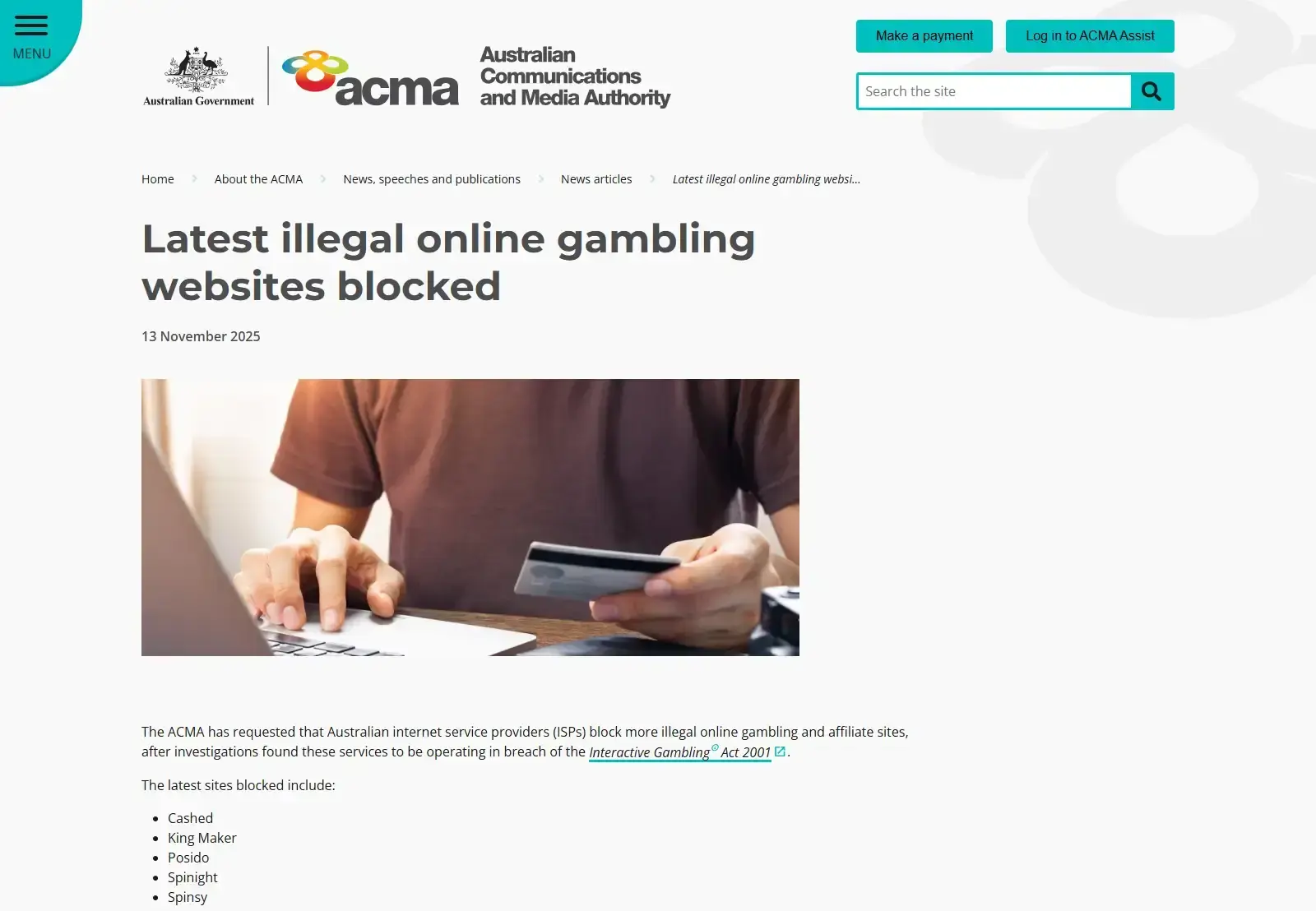
| 13 November 2025 | ACMA publicly named Spinsy among sites it requested Australian ISPs to block. | The regulator used website blocking as a disruption option after finding the listed services operated in breach of the IGA. |
| January 2026 report | ACMA’s October to December 2025 enforcement report lists the NovaForge formal warning for Spinsy, Cashed, Spinight and King Maker. | The quarterly enforcement report independently preserves the action in ACMA’s published compliance record. |
The official 13 November 2025 blocking announcement names Spinsy directly. ACMA’s formal-warning publication identifies NovaForge and the group of services covered by that warning.
Why the Australian-customer link matters in the warning
The formal warning does not depend on the operator being physically located in Australia. It states that the investigated services had an Australian-customer link. Under the IGA framework cited by ACMA, that link exists where customers of the gambling service are physically present in Australia.
ACMA also states in the warning that NovaForge was not licensed by an Australian State or Territory to provide the relevant regulated interactive gambling services to Australians. The current ACMA register used to check licensed interactive gambling providers likewise does not show Spinsy or NovaForge. That supports a precise statement: the current register does not list Spinsy or NovaForge as licensed providers.
It would be inaccurate to stretch that finding into a claim about an exact offshore licence number or status. The Australian record establishes the local finding. Any offshore licence number would need its own authoritative current register or primary licence source. This site therefore does not fill that gap with repeated affiliate-site labels.
What an ACMA ISP-blocking request actually means
Website blocking is one of ACMA’s enforcement and disruption tools. In the November 2025 announcement, ACMA said it had requested Australian ISPs to block the listed illegal gambling and affiliate sites after investigations found the services operating in breach of the IGA. Spinsy was one of the names on that list.
A blocking announcement is strong evidence that ACMA took action against the listed service or site. It is not, however, a continuous technical measurement of every domain an operator might use later. Domains can change, providers can add mirrors, DNS responses can differ, and the exact implementation timing can vary by ISP. For that reason, the accurate wording is that ACMA requested blocking and named Spinsy in the action – not that every current Spinsy address is necessarily unreachable at every instant.
This guide also does not provide workarounds, alternate domains or instructions for evading an ISP block. The editorial value is in documenting the regulator’s action and explaining its limits, not in helping a reader bypass it.
The current ACMA register and later enforcement reports add context
ACMA’s current operator-check page says an online wagering service must be on the register of licensed interactive gambling providers to operate in Australia. The register page was updated on 7 September 2026. A current check does not show Spinsy or NovaForge as a licensed provider.
Later ACMA enforcement reports show that NovaForge continued to appear in regulatory action involving other brands during 2026. That does not automatically create a new Spinsy finding, and this page does not treat action against a different NovaForge brand as if it were a fresh Spinsy case. Its relevance is narrower: the NovaForge name in the 2025 Spinsy warning is not a historical company reference that vanished from subsequent ACMA reporting.
The strongest Spinsy-specific evidence remains the formal warning and the November 2025 blocking announcement. Where a later report concerns another service, the brand named in that later action should stay attached to that later action.
Why the enforcement record matters to an Australian player’s risk assessment
ACMA warns that illegal gambling services may not provide the same customer protections as licensed Australian services and that users can have difficulty recovering money. It also notes that website blocking can affect access. Those are regulator warnings about the category of service and the consequences of using services outside the licensed framework.
For a reader with money already in an account, the enforcement record is especially relevant to access and dispute planning. If a site becomes harder to reach, the practical importance of preserving transaction records, KYC submissions and support correspondence increases. The Spinsy withdrawal process guide explains the operator’s stated cashout workflow and the distinction between finance-team handling, verification and later payment-provider stages.
That connection should not be overstated. ACMA’s blocking action does not prove that a particular withdrawal will fail, just as a successful individual withdrawal would not erase the regulator’s finding. Regulatory status and account-level payment outcomes are different evidence streams.
What the ACMA record does not prove
- It does not prove that every current Spinsy domain is blocked for every Australian internet connection.
- It does not establish the outcome of a specific player’s account, KYC or withdrawal dispute.
- It does not verify a current offshore licence number or licence expiry date.
- It does not make complaint-platform allegations automatically true or representative.
- It does not provide a factual basis to speculate about NovaForge’s motives or predict future ACMA action.
This discipline matters because the public record is already strong without embellishment. The regulator has documented the investigation, findings, formal warning and blocking action. Adding unsupported claims would make the page less accurate, not more informative.
Regulatory evidence and player feedback answer different questions
ACMA records tell readers what the regulator found and what action it took. Public reviews tell readers what individual customers say happened in their own accounts. Both can matter to a decision, but they have different evidentiary weight and different limitations.
The Spinsy reviews and complaints analysis therefore keeps withdrawal-delay reports attributed to the relevant platforms and separates open, resolved and otherwise incomplete cases. It does not use user reviews to rewrite ACMA’s legal findings, and this page does not use ACMA action to claim that every complaint is validated.
The full Spinsy Australia review links these separate evidence types together while keeping their scopes intact.
How to verify the Spinsy enforcement record yourself
Use the regulator’s own dated pages rather than a copied casino-review summary. Start with ACMA’s November 2025 blocking announcement and confirm that Spinsy appears in the official list. Then open the formal-warning publication for NovaForge and check the service names, the Australian-customer-link finding and the statement about Australian State or Territory licensing. Finally, use ACMA’s current operator-check page for the live licensed-provider register rather than assuming the 2025 position remains unchanged forever.
This sequence separates historical evidence from current status. The blocking notice proves a dated action, the warning proves the findings ACMA made in that investigation, and the register answers the narrower current licensing question. If a future register update or enforcement publication changes one of those facts, that newer primary source should replace the corresponding statement rather than being blended with the older record.
How the ACMA record changes the risk picture for Spinsy in Australia
The ACMA record adds a concrete Australian regulatory dimension that cannot be reduced to a missing licence badge. Spinsy was named in a November 2025 ISP-blocking request, NovaForge received a formal warning after ACMA found contraventions involving services including Spinsy and customers physically present in Australia, and the current licensed-provider register still does not show Spinsy or NovaForge.
For an Australian reader, those facts mean that local authorisation and local regulatory protections should not be assumed merely because a Spinsy page, account feature or AUD term is accessible. At the same time, the evidence should be kept within its boundaries. The historical blocking action does not prove the live status of every current domain, and the formal warning does not decide a particular customer’s withdrawal dispute. The strongest use of the record is precise: treat Australian access and recourse as material risks, keep product claims sourced separately, and rely on the dated ACMA documents for what the regulator actually found.