
Withdrawal delay is the clearest recurring complaint theme in the current scan
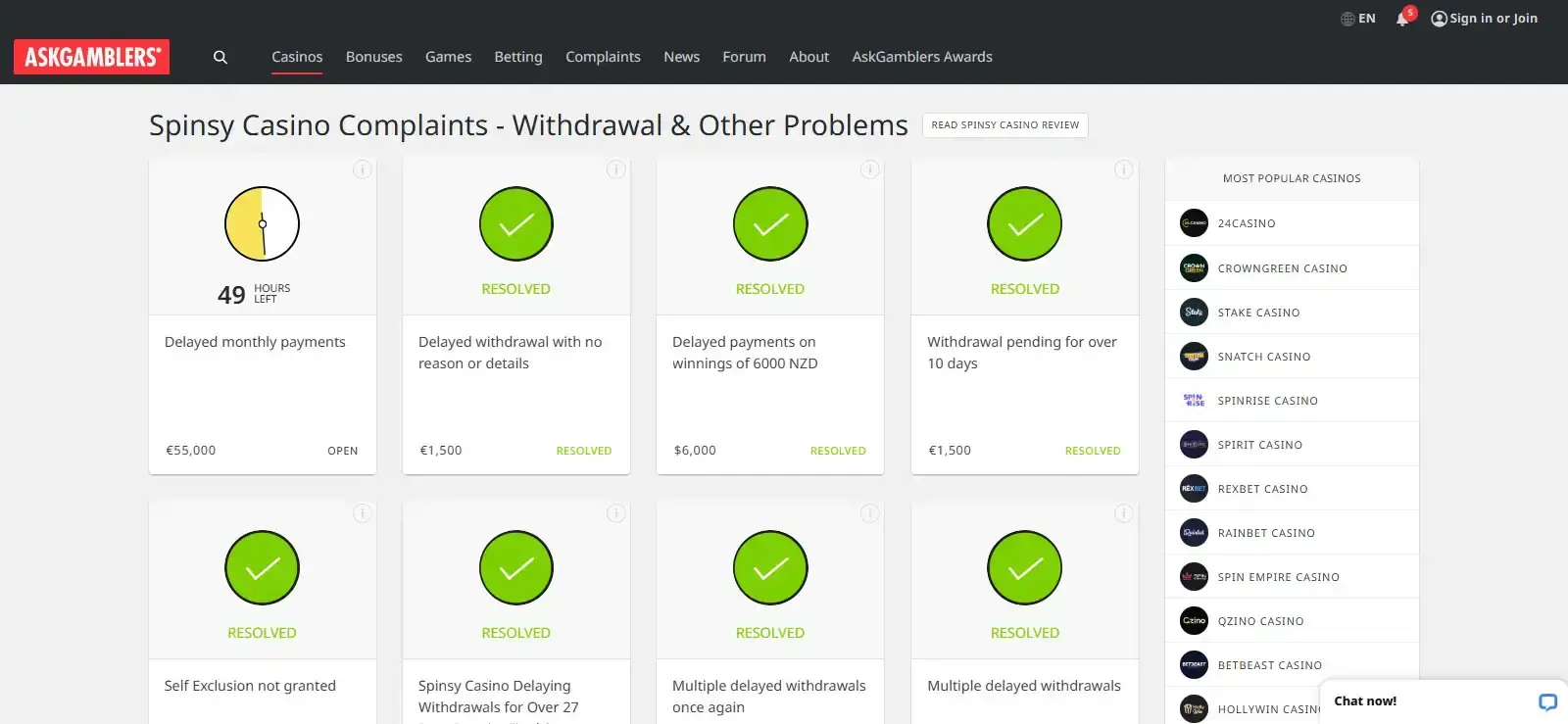
Across the current AskGamblers, Casino Guru and Trustpilot surfaces checked for this page, delayed or disrupted withdrawals appear repeatedly. Some posts describe requests remaining pending beyond the timeframe the customer expected. Others describe payment requests being cancelled, delayed while KYC is active, or processed only after additional contact and time.
That recurrence is enough to identify a review theme. It is not enough to calculate a delay rate. These platforms do not provide the total number of Spinsy withdrawals, the number completed without complaint, or a controlled sample of customers. A group of complaint posts therefore shows that the issue occurs and attracts public reporting, but not how likely it is for a random customer.
The official withdrawal process provides the baseline for comparison. The current Terms say the finance department works withdrawal requests within three business days after the request, or after the prior withdrawal is paid, provided conditions are met and checks are complete. That is a conditional internal handling rule, not a universal promise that funds arrive in an external account within exactly three days.
What the current public sources show
| Source type | Current pattern observed | What can be concluded | Main limitation |
|---|---|---|---|
| AskGamblers complaints | Several delayed-withdrawal cases are listed, including resolved cases and at least one current open delay case. | Delayed payment processing is a recurring complaint category on the platform. | Complaint users self-select, cases can change status, and the listing is not the full Spinsy customer population. |
| Casino Guru complaints | Recent cases include pending withdrawals, account/KYC complications and both open and resolved outcomes. | The same broad withdrawal-delay theme appears on a second independent complaint surface. | Case summaries depend on the documents and messages supplied within each complaint process. |
| Trustpilot reviews | Recent reviews include negative withdrawal-delay narratives as well as positive reports of successful or quick withdrawals. | Public sentiment is mixed rather than uniformly one-directional. | Ordinary reviews are not formal investigations and may not include enough evidence to verify every factual allegation. |
The current AskGamblers Spinsy complaints page, a current Casino Guru withdrawal-delay case and the Spinsy Trustpilot profile are useful examples of why source and status need to travel with any complaint claim.
Open, resolved and abandoned complaints should not be treated alike
A complaint marked resolved provides evidence that a dispute was reported and that the complaint platform later recorded a resolution. It does not mean the original delay never occurred. Conversely, an open complaint shows an unresolved allegation at the time of the scan, but it does not prove the final outcome because the case can still change.
Rejected, abandoned or closed cases need even more care. A complaint can close because the user stops responding, changes the requested remedy, plays the pending funds, or fails to provide evidence. Those endings are not interchangeable with a platform finding that the casino did nothing wrong.
This is one reason raw complaint counts are a poor shortcut. A list containing ten entries can include multiple outcomes, repeated customers, follow-up cases and issues that are not withdrawals at all. The status and chronology of each record usually contain more decision value than the total count.
How complaint narratives compare with Spinsy’s stated withdrawal rule
Spinsy’s current Terms say the financial department works withdrawal requests within three business days after a request is made and/or within three business days after the previous withdrawal request is paid, provided all other conditions are met and checks are complete. The Terms also allow a maximum of three pending withdrawals and permit processing to be delayed for identity, balance, source-of-funds and compliance checks.
That official wording creates a useful comparison point for a complaint. If a customer reports waiting seven or fourteen business days, first ask whether the case was still in the finance queue, whether KYC or another check was open, whether an earlier withdrawal was still unpaid, and whether the payment had already left the finance department. Without those details, the word “late” can refer to different stages.
Several public cases nevertheless describe waits well beyond the internal period the customer expected, even where the user says support acknowledged broader processing delays. Those reports matter because they show real customers publicly describing a gap between the advertised or contractual expectation they understood and the experience they say they received. They still do not prove intent or a universal pattern.
Examples of the range of current outcomes
AskGamblers currently lists multiple delayed-withdrawal cases with different outcomes. Some are marked resolved after the complainant later confirmed receipt of funds. The same listing also shows an open delayed-payment case at the time of this scan. That mix is important: the platform records both the initial problem and, where available, what happened later.
Casino Guru likewise has recent withdrawal-delay records. One current September 2026 case from an Australian user describes three pending withdrawals for close to two weeks and remains open at the time checked. Other 2026 cases on the platform were later marked resolved after payments progressed. These individual records support the existence of a recurring theme, not a prevalence estimate.
Trustpilot adds another kind of signal because it is a general review site rather than a structured casino complaint process. Recent posts include negative accounts of delayed withdrawals and a review updated after one part of a disputed withdrawal was processed. The same profile also contains customers reporting successful withdrawals. The mixture reinforces the need to keep both negative and positive outcomes visible rather than selecting only one side.
Why public review data cannot answer how common the problem is
Review data has several built-in sampling problems. First, participation is voluntary. A customer with a frustrating unresolved payment may have more reason to post than someone whose withdrawal arrived normally. Second, a single person can create more than one case over time. Third, complaint sites often publish only the account history shared by the parties, not bank-side or payment-processor records.
There is also a timing problem. A page view or search result captures a case at one moment. A complaint marked open today may be resolved next week. A customer may edit a review after receiving a partial or full payment. This page therefore date-stamps its scan rather than carrying status labels forward indefinitely.
Finally, geography matters. Many public complaints come from countries other than Australia. They can still reveal operational themes such as delayed processing, but they cannot establish that an Australian customer will experience the same payment route, KYC check or limit. Currency, payment provider and account tier can all differ.
Complaint evidence should stay separate from the ACMA record
Player reports and regulator findings are different evidence types. The Spinsy and ACMA enforcement record documents formal Australian regulatory action, including the 2025 blocking request and NovaForge warning. Those facts come from ACMA primary sources, not from public review sentiment.
A complaint cannot prove an ACMA legal finding, and an ACMA finding cannot prove the details of an individual user’s payment dispute. Keeping the sources separate avoids two opposite errors: treating every angry review as established fact, or dismissing all complaint reports because they are anecdotal.
The broader legal status and licence guide should be used for local authorisation, consumer-protection and BetStop questions. This page is for reputation evidence and complaint methodology.
A practical checklist for reading any new Spinsy complaint
- Date: Is the complaint recent enough to reflect the current Terms and current payment environment?
- Amount and currency: Does the reported amount interact with the account’s daily or monthly withdrawal limit?
- KYC status: Was verification complete, requested later, or still disputed?
- Bonus use: Was the withdrawal connected to active wagering requirements or another bonus condition?
- Queue position: Were there already pending withdrawals, given the Terms allow up to three at a time?
- Processing stage: Was the request still with the finance department or already sent to a payment provider?
- Resolution status: Did the platform later mark the complaint resolved, rejected, closed or still open?
- Evidence quality: Does the case include dated support messages or transaction status information, or only a broad allegation?
Applying the same checklist to positive reviews is equally useful. A claim of a very fast payout still needs context about amount, verification state, payment method and whether the reviewer had earlier withdrawals. Positive anecdotes are not automatically more representative than negative ones.
Where reputation evidence fits in the full Spinsy Australia review
The full Spinsy Australia review treats complaint evidence as one input among several. Product features come from current brand and independent product sources. Withdrawal rules come from the Terms. Australian regulatory status comes from ACMA. Public complaints add evidence about the kinds of problems some customers report and how individual cases develop over time.
This separation produces a more useful decision framework than a single star score. A reader can see the official rule, the regulator context and the public case history without pretending those sources measure the same thing.
How to read Spinsy withdrawal complaints without overgeneralising
The current public record supports one careful finding: delayed withdrawals and payment-processing difficulties are a recurring theme across more than one independent Spinsy review or complaint platform. It also shows mixed outcomes, with some cases resolved, some still open, and ordinary review pages containing both negative and positive withdrawal experiences.
That evidence is most useful when compared with the official withdrawal process rather than converted into a claim about every account. Check the complaint date, amount and currency, KYC status, number of pending requests, any bonus conditions and the final resolution. A case that remains unresolved after a long wait deserves different weight from one that was later paid, but neither tells you the percentage of all customers who experience the same problem. Treat the theme as a signal worth investigating, preserve its source and status, and avoid turning anecdotal case data into a claim of systematic misconduct that the public evidence cannot establish.